Apply ASCE 7-22 tornado-load provisions, calculate MWFRS and C&C pressures, and compare tornado and wind demands using a hospital case study.
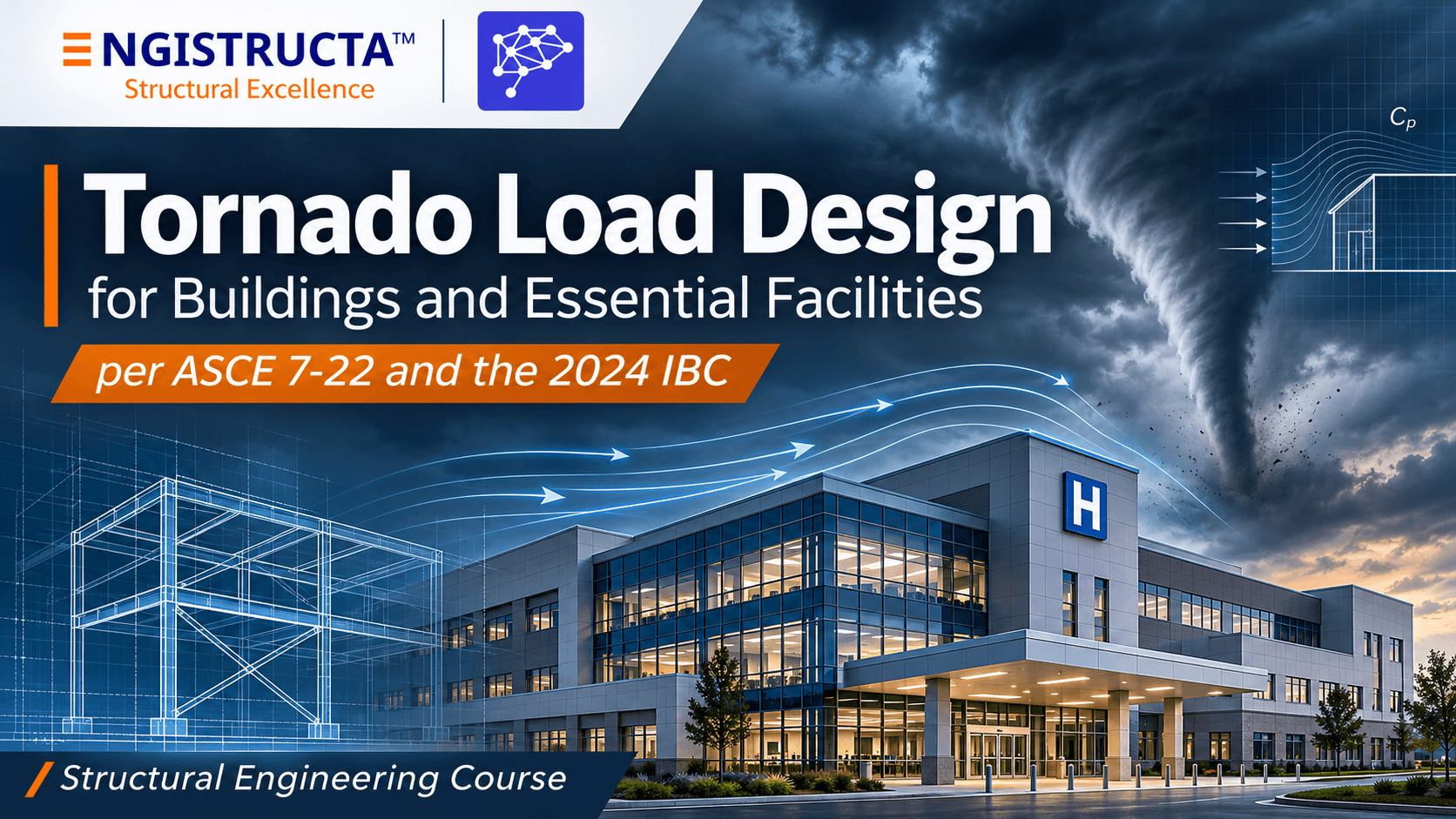
When is a building in a tornado-prone region actually required to be designed for tornado loads—and when will conventional wind design still govern?
ASCE 7-22 introduced minimum tornado load requirements into conventional building design through the new provisions of Chapter 32. These requirements create an important new responsibility for structural engineers, particularly when evaluating Risk Category III and IV buildings, Essential Facilities, and structures located within the tornado-prone region of the United States.
This course provides a practical, step-by-step guide to determining when tornado load design is required and how tornado pressures and forces are calculated in accordance with ASCE 7-22 and the 2024 IBC. Rather than simply listing code provisions, the course explains how the new tornado design parameters interact and how they differ from the wind-load procedures already familiar to practicing engineers.
Participants will learn how to evaluate Risk Category, geographic location, tornado speed, basic wind speed, and effective plan area to determine whether Chapter 32 applies. The course then develops the tornado design process through the calculation of tornado velocity pressure, enclosure classification, internal and external pressure coefficients, tornado directionality, gust effects, vertical-pressure adjustments, and design pressures for both the Main Wind Force Resisting System and Components and Cladding.
Special attention is given to issues that can significantly affect the performance and continued operation of Essential Facilities, including the protection of glazed openings, tornado missile-impact requirements, changes in enclosure classification after glazing failure, rooftop equipment, and rooftop photovoltaic systems.
The course also explains how tornado loads are incorporated into strength-design and allowable-stress-design load combinations, why wind and tornado loads are evaluated separately, and how engineers determine which loading condition controls individual structural and building-envelope components.
A detailed worked example evaluates a five-story hospital and its supporting central utility plant in Tulsa, Oklahoma. The example compares ASCE 7 wind and tornado pressures for roof systems, roof overhangs, windows, parapets, and rooftop equipment, demonstrating that tornado loads may control some elements even when the mapped tornado speed is lower than the basic wind speed.
By completing this course, participants will be better prepared to determine when tornado design is required, calculate ASCE 7-22 Chapter 32 pressures and forces, compare tornado and conventional wind demands, protect critical building-envelope components, and develop defensible code-compliant designs for buildings and Essential Facilities.
2 activities • 1 chapters • duration: 2 hours

Professor of Reinforced Concrete Structures | Structural & Forensic Engineering Consultant | Wyoming-Licensed P.E. | CPD Course Author
Dr. Ibrahim M. Metwally, Ph.D., P.E., is a Wyoming-licensed Professional Engineer specializing in civil and structural engineering, structural and forensic engineering consultancy, and continuing professional education. He serves as Professor of Reinforced Concrete Structures at the Housing and Building National Research Center (HBRC) in Cairo, Egypt. He is the Founder and Principal Consultant of ENGISTRUCTA™ | Structural Excellence, a structural and forensic engineering consulting practice registered in Wyoming. He is also registered as an independent structural engineering consultant with the Wyoming Department of Transportation (WYDOT) and as a structural consulting engineer with Egypt’s Ministry of Housing, Utilities and Urban Communities. With more than 30 years of academic, research, and professional experience, Dr. Metwally specializes in structural analysis and design, forensic investigation, structural assessment, rehabilitation and strengthening, seismic and wind engineering, performance-based evaluation, and advanced nonlinear finite element analysis. His technical expertise encompasses reinforced concrete, structural steel, prestressed and post-tensioned concrete, deep foundations, structural masonry, bridges, buildings, and infrastructure systems. His professional experience includes the design, review, evaluation, rehabilitation, and failure investigation of major structures across Egypt and the Arabian Gulf region, including projects involving deterioration, structural distress, complex loading conditions, and extreme environmental effects. His academic and research interests include ultra-high-performance concrete (UHPC), fiber-reinforced polymer (FRP) structural systems, large-scale experimental testing, seismic performance, and the behavior of concrete structures under extreme loading. As an author and technical reviewer of continuing professional development (CPD) courses for professional engineers, Dr. Metwally integrates current codes and standards, advanced technical knowledge, worked examples, and practical engineering judgment. His educational materials help practicing engineers strengthen their capabilities in structural design, assessment, rehabilitation, forensic engineering, and code compliance.
